Which Sewing Machine Needle for Which Fabric? Types and Sizes Explained
As an Amazon Associate we earn from qualifying purchases. Some links on this page are affiliate links, which means we may earn a small commission if you make a purchase.
Look at the needle currently in your machine. On its flat shank, you’ll find a stamped number: 130/705H. This isn’t a brand code—it’s the UK domestic sewing machine needle system, encoding the shank diameter, length, and point geometry class. Getting this system right matters more than the brand name on the packet, because the needle’s geometry determines whether it slices cleanly through cotton, pushes apart knit fibres, or handles heavy denim without deflection.
You’re three seams in when the thread snaps again. You rethread. Snap. Rethread, presser foot down, and the needle punches through a couple of stitches before it snags. The fabric bunches, the top thread loops underneath in a tangled mess, and you’re wondering whether you’ve somehow broken a machine that was working fine last month.
Before you reach for the tension dial — stop. The needle is a common reason. Not the machine, not the thread, not the settings you’ve been tweaking. A needle that is the wrong type, the wrong size, or just plain worn out will cause skipped stitches, thread breaks, and puckering on almost any domestic machine. The fix is a new needle, but the fix only works if it’s the right needle for what you’re sewing.
This guide tells you exactly which one that is — and why the size number on the packet is only half the story.
Why needle choice affects stitch quality
Most of what people call “tension problems” are actually needle problems. Skipped stitches, thread snapping, fabric snagging, puckering along the seam — these are the classic symptoms, and a new, correctly matched needle often clears them. The honest check order for any of these symptoms is: rethread the top thread with the presser foot raised, fit a new needle of the right type, check the bobbin, clean out the lint, and only then consider adjusting tension. If you skip the new needle step, you’re usually fixing the symptom and missing the cause.
📺 Watch: How to Sew with a Twin Needle
There is also a persistent myth that deserves to be retired: the idea that Singer machines require Singer needles, or that using another brand will somehow damage the machine. This is not true for most modern domestic machines with a flat shank. Many modern domestic machines use the 130/705H system — named by international needle manufacturers — and a Schmetz, Organ, Hemline or Klasse needle in this system will typically fit and work correctly in a Brother, Janome, Bernina, Elna, Pfaff, or Singer. Check your manual to confirm your machine takes this system before substituting needles.
What matters is not the brand on the packet but whether the needle type matches your fabric. A sharp needle on a stretch jersey will damage the fibres and skip stitches. A ballpoint on a tightly woven cotton may produce an uneven stitch. That’s not a machine problem — that’s a needle problem.
Understanding needle system, size, and point geometry
Three things determine how a needle performs: the system, the size, and the point geometry. All three affect needle selection.
The 130/705H system is a widely used standard for domestic sewing machines with a flat shank. The code describes the flat-shank and scarf designation — it is not a brand name. Schmetz and Organ both use this system, which means any needle in this range fits any domestic machine that accepts a flat shank. If your machine manual specifies the 130/705H system — and many do — then you have a broad range of needle types available regardless of who made the machine.
Needle size is expressed as two numbers: a European size (for example, 80 or 90) and an American size (12 or 14). They describe paired size designations. Smaller numbers mean a finer needle; larger numbers mean a thicker one. The two-number system exists simply because different markets historically used different conventions.
Point geometry is what most people skip, and it’s the part that actually determines whether a needle works for your fabric. The tip of the needle is ground to a specific shape:
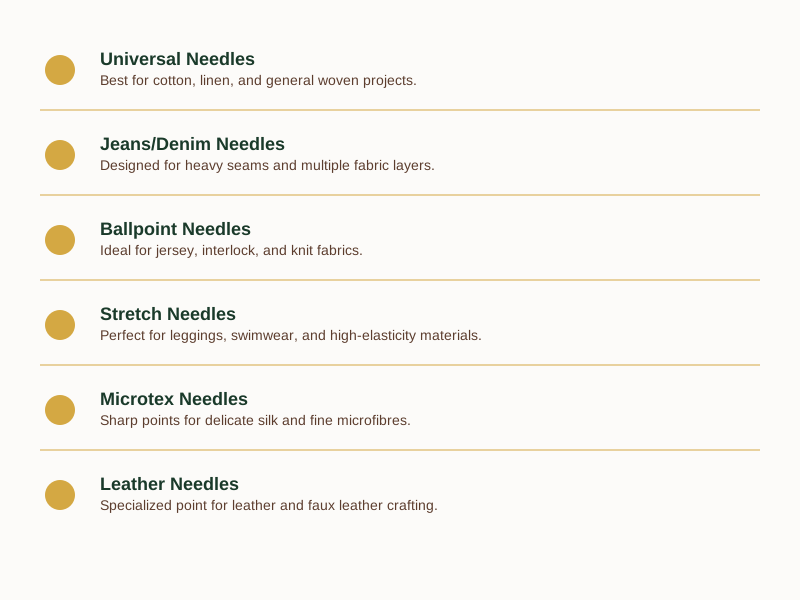
- A sharp needle has a fine, acutely pointed tip that cuts through woven fabric fibres cleanly. It is the right choice for cotton, linen, poplin, and densely woven synthetics.
- A ballpoint needle has a rounded tip that pushes fabric fibres apart rather than cutting them. This prevents the snagging and laddering that occurs when a sharp needle pierces the loops of a knit fabric. It is the right choice for jersey, interlock, sweatshirt knit, and most stretch fabrics that are not highly elastic.
- A stretch needle has a special eye and scarf shape that help prevent skipped stitches on highly elastic fabrics. It outperforms ballpoint needles on leggings, swimwear, Lycra blends, and other fabrics with significant stretch recovery.
- A jeans needle has a heavier shaft, a sharper point, and more shaft stiffness to penetrate multiple layers of heavy woven fabric without deflection. Standard universal needles can deflect or skip when hitting the seam allowance of a pair of jeans; a jeans needle goes straight through.
- A microtex needle has an ultra-fine acute point — sharper even than a standard sharp — that produces a very clean entry hole in tightly woven, delicate, or densely constructed fabrics. Silk, microfibres, batiks, and quilting cotton benefit from this precision.
Eye design can affect thread handling. A well-made needle with a cleanly finished eye is kinder to the thread, which is worth paying a little extra for if you keep getting thread breaks.
The mechanism is straightforward: the point shape determines how the needle interacts with the fabric’s structure, and the eye shape determines how the thread interacts with the needle. Both of these matter more than whether the packet says “universal” or “Singer”. This is why the 130/705H system matters — it tells you the needle will fit your machine; the point geometry tells you whether it will actually work for what you’re sewing.
Choosing needles by fabric type
Here is what to use and when, based on fabric type and the symptoms you’re most likely to encounter.
📺 Watch: A Guide to Sewing Machine Needles
Universal needles (paid link)See on Amazon — for cotton, linen, poplin, and general-purpose woven fabrics. If you’re sewing a cotton shirt, hemming trousers, or doing a straightforward repair on a non-stretch fabric, a universal needle is almost always the right call. For regular sewing, premium brands like Schmetz tend to offer more predictable performance.
Jersey/ballpoint needles (paid link)See on Amazon — for T-shirts, dresses, children’s clothes, and ordinary jersey or interlock. The rounded tip is what stops the needle from snagging on and damaging knit fibres, which is why this is the first needle type to reach for when switching from woven to stretch fabric. The rounded tip means fewer skipped stitches and less snagging on standard knit fabrics. The limitation is that jersey needles are not the right tool for high-elasticity fabrics such as Lycra or swimwear; that’s where stretch needles take over.
Stretch needles — for leggings, swimwear, sportswear, and fabrics with significant elastic recovery. The deeper scarf and modified eye reduce thread friction during the needle’s rapid movement on stretchy fabric, which is why skipped stitches on Lycra or elastic jersey may reduce after switching to a stretch needle. They suit swimwear and intimates. If you’re making something that snaps back when you let go of it, a stretch needle is the right call.
Jeans needles (paid link)See on Amazon — for denim, canvas, bags, and heavy seams. The heavier shaft and sharper point penetrate reliably through multiple layers without deflecting. For most jeans, 90/14 covers lighter denim and 100/16 handles thicker layers as starting points — follow your machine and needle manufacturer’s guidance. If you’re sewing bags or canvas items, 100/16 is the sensible starting point. A 110/18 needle may be excessive for lighter denim.
Microtex needles (paid link)See on Amazon — for silk, microfibres, lining fabrics and other fine or densely woven fabrics. The ultra-sharp point is designed to make clean penetrations in densely woven fabrics. The trade-off is durability: sharper points dull faster, and microtex needles are more prone to damage on heavily constructed seams. They are also not the right choice for knits — a ballpoint or stretch needle is safer on any fabric with a loop structure.
Leather needles (paid link)See on Amazon — for real leather, suede, and heavy non-woven materials. The chisel-shaped point cuts a clean entry hole in material that has no give. They suit jobs like bag making and leather jacket alterations. A couple of important limitations: they are not suitable for knit or woven fabrics, and soft faux leather can be torn by the chisel point rather than cleanly pierced. If you’re working with imitation leather, test on a scrap first.
If you’re not sure which needle type you need and your projects vary across fabric types, an assorted pack is a practical starting point. A Schmetz assorted pack gives you a range of sizes in the universal and specialist types, which is useful when you’re building your kit. The limitation is that you may end up with sizes you don’t need — fine if you don’t yet know which size suits your machine and fabric, but less ideal if you already know exactly what you’re looking for.
Matching needle size to your project
The two-number system catches a lot of people out. Here’s the straightforward version: the European number (60 to 110) and the American number (8 to 18) describe paired size designations using two different conventions.
From thinnest to thickest, the European sizes run roughly 60, 70, 80, 90, 100, 110. The American equivalents are roughly 8, 10, 12, 14, 16, 18. They correspond directly: 80/12 is the same diameter needle, 90/14 is the same diameter needle, and so on. The European number is generally more useful because it maps more precisely to the metric system most UK fabric shops use when describing thread weights.
As a rule of thumb, match the needle size broadly to your fabric weight and thread thickness:
- 60/8 to 70/10 — very fine fabrics, sheer silks, microfibres, lightweight batistes
- 80/12 — standard woven fabrics, quilting cotton, medium-weight dressmaking fabrics
- 90/14 — heavier woven fabrics, light denim, canvas, thick cotton
- 100/16 to 110/18 — heavy denim, canvas, multiple layers, bags, workwear
If you’re unsure, err towards the finer needle for the fabric weight. A needle that’s slightly too thick will leave visible holes and may skip stitches; a needle that’s slightly too fine will cope with lighter fabric without damage and can always be swapped for something heavier if the fabric needs it.
When to replace your needle
A needle does not last the life of a sewing project. It has a finite working life, and a blunt or damaged needle will cause the same symptoms as a wrong needle type: skipped stitches, thread breaks, fabric snags, and a rough feel under the presser foot.
A common rule of thumb is to change your needle every six to eight hours of actual sewing, or after every major project. This reflects the reality of needle wear. Needles can become dull, damaged, or bent with use. These issues are often invisible to the naked eye but immediately apparent in the finished seam.
Before you start your next project, hold the needle up to the light and look at the point. If it looks dull or rounded rather than sharp and defined, replace it. If you’ve been sewing with it for more than a couple of sessions, replace it anyway — it’s one of the cheapest parts of the machine and one of the most consequential for stitch quality.
If you’re experiencing persistent skipped stitches after confirming the needle type and size are correct, check the bobbin area for lint buildup. Lint between the bobbin and the bobbin case can affect thread tension enough to cause the same symptoms as a wrong needle. A clean lint brush and a visual check can save a lot of frustration.
Needle Types by Fabric
| Fabric Type | Needle Type | Best For |
|---|---|---|
| Cotton, linen, poplin | Sharp | Woven fabrics, quilting |
| Jersey, interlock | Ballpoint | T-shirts, dresses, knits |
| Leggings, swimwear | Stretch | High-elasticity fabrics |
| Denim, canvas | Jeans | Heavy seams, multiple layers |
| Silk, microfibres | Microtex | Delicate, fine fabrics |
| Leather, faux leather | Leather | Non-woven materials |
| General purpose | Universal | Everyday sewing |
| Mixed projects | Assorted pack | Versatile kit starter |
Questions and answers
Can I use Singer needles in my Brother or Janome machine?
Yes, if the Singer needle uses the 130/705H system — and most modern Singer needles do. Singer-branded needles that are longer or have a differently shaped shank are designed for older Singer-specific machines and may not seat correctly in a modern flat-shank machine. For any modern domestic machine, the 130/705H system is the universal standard, and a Schmetz, Organ or Klasse needle in this system is a perfectly good choice.
What’s the difference between a ballpoint and a sharp needle?
A sharp needle has a fine, pointed tip that cuts through woven fabric fibres. A ballpoint needle has a rounded tip that pushes the fibres apart. For woven fabrics — cotton, linen, denim — a sharp needle produces a cleaner, more precise stitch. For knit fabrics — jersey, interlock, stretch T-shirt fabric — a ballpoint or stretch needle prevents the needle from piercing and damaging the loop structure of the fabric, which is what causes snagging and laddering.
Why is my thread breaking even with a new needle?
If you’ve fitted a new needle and the thread is still breaking, the issue is likely in the threading path or the bobbin. Rethread the entire top thread with the presser foot raised, check that the bobbin is seated correctly and the thread is threaded in the right direction for your machine type, and clean any lint from the bobbin area. Thread quality can also be a factor — very old thread or budget thread with inconsistent thickness will break more easily, particularly with a new needle that exposes any weakness.
How often should I change my sewing machine needle?
Every six to eight hours of sewing or after every major project is a common rule of thumb. A needle may need replacement after extensive sewing or if stitch quality deteriorates — even if it looks fine to the eye. Keeping a supply of fresh needles means you’re never tempted to “just get through one more seam” with a worn needle.
Now you know what to look for — the point geometry, the eye shape, and the size that matches your fabric weight. A new needle in the right type is the single most effective thing you can do for stitch quality, and it costs a few pounds. Before you adjust a single dial or call a repairer, it’s worth working through the needle check.
If you’re still not sure which needle to try first for the fabric you’re working with, or if you want a quick-reference checklist to work through when your machine misbehaves, grab the free Sew and Fix Fault-Finding Checklist — it’s a straightforward guide to work through in order, starting with the cheap, easy fixes before anything more involved.
The right needle is out there. Once you know what to look for on the packet, the choice is straightforward — and the difference in your seams will be immediately apparent.
One needle type should never be used on a domestic machine regardless of fabric: the industrial system needle. Its longer shaft and different shank geometry can cause physical damage to your machine’s timing and hook mechanism. Stick to the 130/705H system needles designed for home machines.
Explore More Topics
Quick answers:
Go deeper on specific topics:
- Which Needle for Denim, Leather and Thick Layers on a Home Sewing Machine?
- Which Thread for Which Fabric? Matching Thread to Needle and Fabric
- How to Sew Sheer and Delicate Fabrics on a Domestic Sewing Machine: Needle and Tension Tips
- Sewing Machine Needle for Quilting and Multiple Layers: What Works and What Doesn’t
- How Often Should You Change a Sewing Machine Needle?
Sources & Further Reading
- Sewing Machine Needles Guide - The Sewing Directory
- How to Choose the Right Sewing Machine Needle - Sew Essential
- Free Download: Schmetz ABC Pocket Needle Guide
Note: General guidance only, verify details with a qualified professional or official source.