Which Oil Can You Use on a Sewing Machine (and What Never to Use)?
As an Amazon Associate we earn from qualifying purchases. Some links on this page are affiliate links, which means we may earn a small commission if you make a purchase.
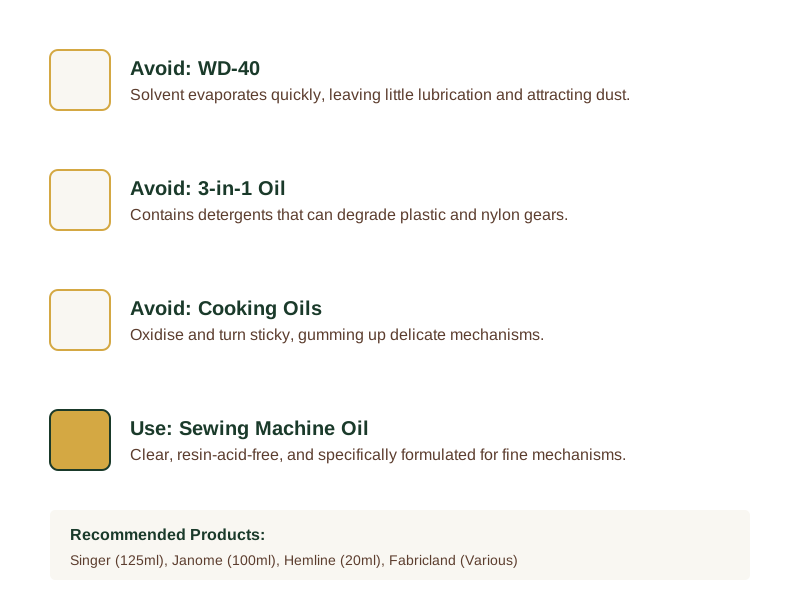
WD-40 leaves a residue that attracts dust, 3-in-1 oil can degrade plastic components over time, and cooking oils oxidise into a sticky gum inside the machine’s mechanisms.
Your Singer or Brother has started grinding, or the hand-wheel feels stiff. You might be tempted by a bottle from the garage or kitchen, but the wrong choice can actively damage the plastic and nylon parts inside modern machines.
This guide tells you what to buy, what to leave on the shelf, and exactly how to apply it without making a mess.
What Actually Happens When You Use the Wrong Oil
Most substances called “oil” in a hardware shop are not suitable lubricants for a sewing machine. They behave differently, and some can harm the internal components.
📺 Watch: Sewing Machines: What Oil Should You Use?
WD-40 is a common mistake. It is primarily a solvent with a light oil carrier, not formulated as a dedicated sewing-machine lubricant. What it leaves behind can attract dust and lint, which is the opposite of what you want. A machine used weekly needs consistent lubrication, not a short-lived spray.
3-in-1 oil contains additives designed for general workshop use. These additives are not intended for the fine mechanisms of a sewing machine. Over time, using lubricants not specified for sewing machines can damage components; by the time you notice the machine running roughly, the cause can be hard to trace. Use only lubricant recommended by the machine manufacturer, especially around plastic or nylon parts.
Cooking oils like olive or vegetable oil are an easy mistake. They are not intended for sewing-machine lubrication and may become sticky or leave residue inside a working machine. Once they turn sticky, they can gum up the shuttle race, the needle bar, and the take-up lever. Clearing this residue from fine mechanisms is a much bigger job than oiling correctly in the first place.
Some modern electronic machines—particularly fully computerised models—are factory-lubricated and sealed. Many manufacturers state in the manual that these models do not need user oiling. Adding oil to a machine not designed for it risks it finding its way onto parts it shouldn’t. Always check your manual before applying any lubricant.
The Never-Use List
- WD-40 and similar penetrating sprays
- 3-in-1 oil
- Cooking oils — olive, sunflower, vegetable
- Hair oil or baby oil
- Any grease not labelled for sewing machines
- General-purpose workshop lubricants unless explicitly marked as safe for plastic
The Verdict — What to Buy and What to Avoid
For UK domestic machines, the only safe choice is a clear, resin-acid-free oil labelled specifically for sewing machines. This indicates a specific formulation. Sewing machine oil is a highly refined mineral oil. Look for descriptions like “super fine,” “clear,” and “odorless” on the product label. If the label doesn’t say it is for sewing machines, it doesn’t go in your machine.
Here is what works, based on availability in the UK:
Singer Super Oil is a super fine sewing machine oil in a reusable 125ml plastic can with a one-drip spout. Singer’s product information says it can be used on all sewing and knitting machines. The precision spout helps apply a single small drop where needed. It is a widely stocked branded option.
Janome General Purpose Sewing Machine Oil is marketed for sewing machines. It is compatible with Janome machines and is a solid general-purpose choice widely available from UK retailers.
Hemline Machine Oil (paid link)See on Amazon comes in a small 20ml bottle, suiting older machines and occasional use. If the nozzle is sealed, clear it with a pin before first use.
If you are on a tighter budget, some retailers sell a general sewing machine oil. For regular use or a machine you rely on, spending a little extra on a recognised brand is worthwhile.
So: Singer Super Oil wins on ubiquity and the precision spout. Janome oil is a good choice for those in that brand’s ecosystem. Hemline suits occasional, precise use. None of these should damage your machine. WD-40, 3-in-1, and cooking oils risk causing problems—that is the call.
How to Oil Your Machine Correctly
You have the right oil. Here is how to apply it cleanly.
📺 Watch: Sewing Machine Maintenance: Oil and Clean
First, unplug the machine. Your fingers will be close to the needle area and hand-wheel.
Second, clean out any lint and dust before adding oil. Use a lint brush (paid link)See on Amazon on the feed dogs, bobbin area, and needle bar. Oiling over lint traps dirt inside, which is worse than not oiling at all.
Third, consult your manual. Some modern machines are sealed and don’t need user oiling. If yours specifies oiling points, it will show you where to apply oil. If it doesn’t mention oiling, don’t proceed.
For mechanical machines that need oiling, the usual points are the needle bar, the shuttle race, and the take-up lever. Apply one small drop at each point—a little goes a long way.
Avoid oiling plastic parts, the motor, the belt, or the electronic board area. Keep oil away from belts and electrical parts unless the manual specifically directs otherwise.
After oiling, turn the hand-wheel by hand to work the oil in. Then run the machine empty for a moment (with a scrap of fabric under the needle to catch stray drops) and wipe away any excess. Wipe all spilled oil promptly.
The sequence in short: unplug → clean lint → check manual → apply one drop per point → hand-wheel → run empty → wipe excess.
A practical tip: check if the nozzle is sealed on a new bottle before you start, so you aren’t searching for a pin mid-job.
When Oil Isn’t the Answer and Calling a Pro
If you want to keep costs down, a retailer’s own brand sewing machine oil can be a budget option. For a machine used every week, the branded options are often worth the small extra cost.
Beyond oil, a basic maintenance kit is useful: compatible bobbins, a lint brush, a seam ripper, and clear sewing-machine oil. These items prevent many problems from becoming expensive.
However, oil doesn’t fix everything. If your machine makes a grinding noise that continues after oiling, or if the hand-wheel remains stiff and resists turning by hand, stop using it. Persistent grinding can indicate a mechanical or motor problem warranting professional inspection. The same applies if the machine smells hot, shows damaged wiring, or has stopped working entirely after normal use.
The distinction is clear: if the issue is stiffness from dryness, oil will likely help. If it’s a grinding, knocking, or seized mechanism, it’s a job for a service engineer. Don’t keep running it hoping it will improve—you risk worse damage.
Frequently Asked Questions
Can I use olive oil on my sewing machine?
No. Olive oil is not intended for sewing-machine lubrication and may become sticky, gumming up the delicate mechanisms inside your machine. Clearing sticky oil is a much bigger repair job than the cost of proper sewing machine oil.
Is sewing machine oil the same as machine oil for cars?
No. Engine oil is not the lubricant specified for sewing machines. It is formulated for different conditions. Use only oil that is specifically formulated and labelled for sewing machines, following the machine manual.
How often should I oil my sewing machine?
This depends entirely on your machine and how often you use it. Your manual is the definitive source—follow its schedule. Cleaning lint out is more critical than frequent oiling; a clean, dry machine in regular use will indicate when it needs lubrication through its sound and feel.
Recommended Sewing Machine Oils
| Product | Volume | Key Feature | Best For |
|---|---|---|---|
| Singer Super Oil | 125ml | Reusable can with precision spout | General use and ease of application |
| Janome General Purpose Oil | (Check product) | Spouted bottle | Janome owners and general compatibility |
| Hemline Machine Oil | (Check product) | Small bottle for precise application | Occasional maintenance and awkward points |
| Retailer General Oil | Various | Budget-friendly option | Occasional maintenance on a tight budget |
📺 Watch: Avoid Sewing Machine Damage: Proper Oiling Tips!
Final Check and Next Steps
The correct approach is clear: use a recognised brand of sewing machine oil, applied sparingly to the points your manual specifies, after cleaning out lint. Using the wrong oil—like WD-40 or cooking oil—will likely cost more in repairs than a bottle of the right stuff.
If your machine runs rough, stiff, or noisy, try basic maintenance first. A new needle, rethreading, and a drop of the correct oil solve many issues that seem serious.
After working through straightforward maintenance, if the machine still grinds, knocks, or runs poorly, it’s time to arrange a service rather than continue troubleshooting.
A correctly oiled machine should move smoothly with a quiet, consistent hum—no grinding, sticking, or rough spots. If you’re unsure which problems relate to oiling, our free Fault-Finding Checklist guides you through checks in the most logical order.
Related Guides
For a complete overview, see our How to Clean, Oil and Look After a Sewing Machine at Home .
Sources & Further Reading
Note: General guidance only, verify details with a qualified professional or official source.